The next generation major scientific project will streamline numerous discoveries
Most people imagine scientists as walking around their labs wearing white coats, looking through microscopes and shaking beakers of fuming chemicals. But some of the research projects are much larger in scale. Take CERN, for example. It is an underground ring 30 miles in diameter, next to Lake Geneva, which is used for accelerating and smashing elementary particles together at vast speeds in an effort to crack them apart. There is also LIGO, which uses large mirrors separated by miles to detect gravitational waves. There are big telescopes and projects such as the ISS (International Space Station) for which several countries had to team up.
AI Rendition of the future Feynman Tunnel (DALL E)
These and other colossal experiments employ thousands of scientists who are trying to answer humanity’s biggest questions related to the origins of the Universe and the nature of matter, even seeking other civilizations. Andrew Longerthought, a philosopher of science from the University of Upper Lowlands, says “In the most existential sense, this gifts us our purpose – as long as we are trying to find the answers, we are truly alive”.
Perhaps for this reason, and also the prospect of staying busy for decades to come, scientists welcomed with exhilaration the news that The House passed into law the $1.2 Bn ‘2024 Feynman Tunnel Act.’ The Feynman tunnel, if the Senate agrees, the President signs, and if funds are subsequently appropriated, will be the next big project, “possibly the most important scientific effort of the XXI century” according to an NIT physicist Hersh Inidics.
Richard Feynman, the namesake of the project, was a Nobel prize winning theoretical physicist, celebrated for discoveries in quantum electrodynamics and superfluidity. He was involved in the Manhattan project and proposed the so-called ‘Feynman diagrams’ – a short-hand pictorial language for writing down complex equations. But scientists know him best not for all this historically relevant work, which is however difficult to understand, but for his famous quote:
“The first principle is not to fool yourself – and you are the easiest person to fool.”
While only a rare scientist can read, let alone write down, even the simplest Feynman diagram, all of them know this quote, and often recite it to each other, with pride. It is this principle that belies the foundation of the Feynman tunnel. The idea that the project is aiming to test is that tunnel vision, often associated with “fooling yourself” can greatly increase the efficiency of any scientist, no matter a physicist, a chemist, a marine biologist or a sociologist. By focusing attention on “the prize,” and not being distracted by lesser explanations, minor or even major errors in research methodology, leaps of logic and other distractions, scientists should be able to attain their discovery goals at never-before-seen rates.
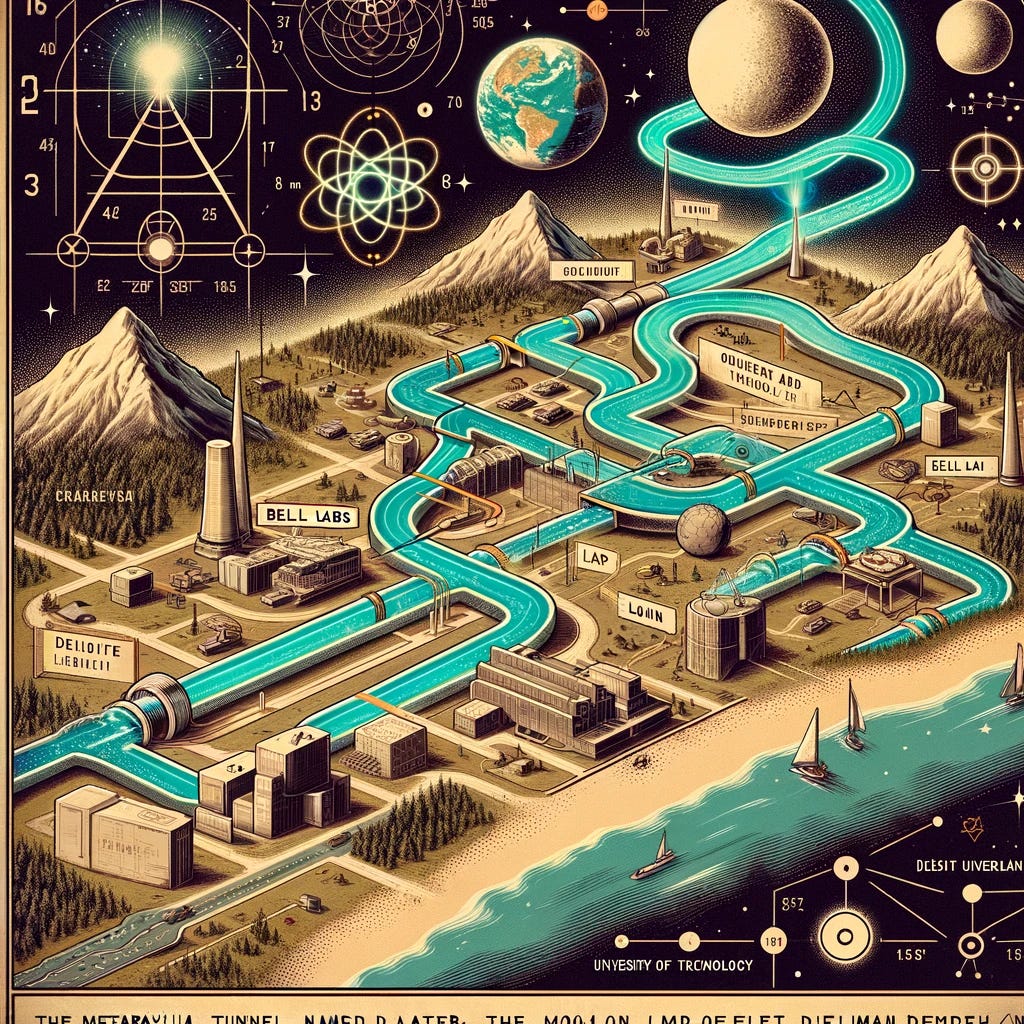
The tunnel is planned as a physical tunnel which reaches extreme lengths and depths and crosses over into a metaphysical tunnel. In the physical world, it will connect Bell labs in New Jersey with Delft Institute of Technology in the Netherlands, crossing through Cambridge, MA and the Moon. Construction will take 10 years, but the metaphysical component already exists and only needs to be “linked up,” according to the journal Nature of Things [citation needed].
“We expect that scientific output will quadruple once the tunnel is fully operational” says Henk Schoenenfrauden, former PhD, the spokesman for the project. Publishing infrastructure needs to be updated, with several thousand new journals planned to start accepting submissions in anticipation of the launch date in 2034. “This will be a revolution not seen since the printing press was first used to slice bread,” added Longerthought.
A Scientist walking down the Garden Path section of the tunnel (DALL E)
 spin and coffee